Emollients can be treated as routine low-cost prescribing
Cost-conscious prescribing matters, but routine does not mean interchangeable. When a first-line emollient is unsuitable, repeating low-cost options can leave the care problem unresolved.
NHS, NICE and prescribing stakeholders
This campaign is raising a system question: whether current eczema prescribing pathways give primary care enough flexibility after documented first-line emollient failure.
The campaign is not asking policy teams to treat individual testimony as clinical proof. It is asking whether repeated patterns of failed first-line prescribing reveal a system question worth measuring.
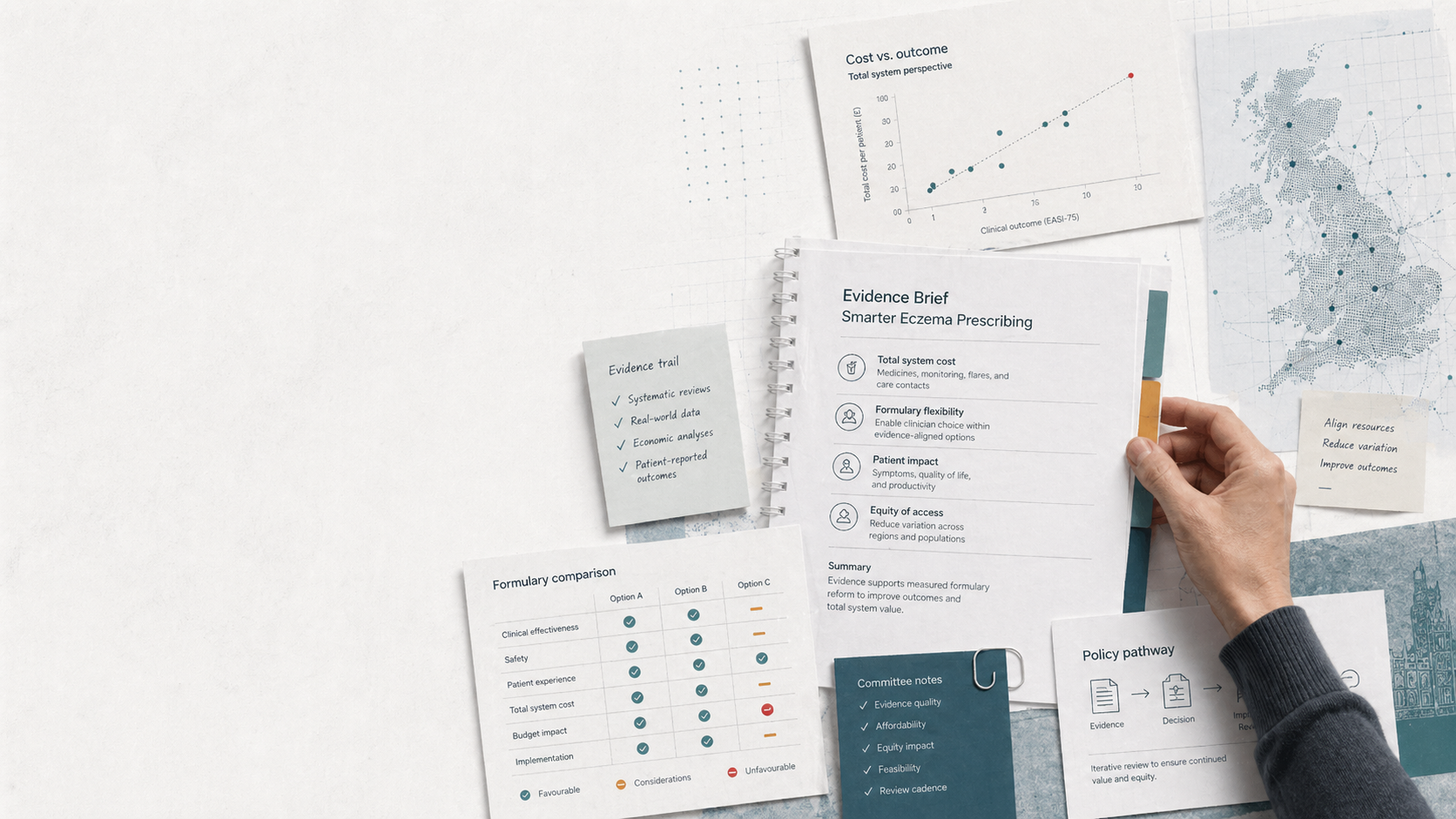
Why this campaign exists
The campaign accepts the need for cost-conscious prescribing. It questions whether unit-cost control is sufficient when suitability and actual use fail.
Cost-conscious prescribing matters, but routine does not mean interchangeable. When a first-line emollient is unsuitable, repeating low-cost options can leave the care problem unresolved.
The campaign frames formulary limits as a system question: how is clinical suitability protected when documented failure points beyond the usual local options?
Choice and acceptability are relevant because an emollient that stings, irritates, feels intolerable, or is not used will not support day-to-day eczema control.
External source: NICE QS44: provision of emollientsThe campaign is about formularies, guidance, prescribing incentives, constrained options, and unclear escalation routes after documented first-line failure.
Formulary flexibility
Where standard options have failed or are not tolerated, the next step should be clear enough for primary care to act before specialist review where clinically appropriate.
Escalation before specialist care
Current waiting-time figures still need sourcing before system-wide claims are made, but the policy logic is clear enough to test.
Treat long dermatology waits as a reason to strengthen primary-care eczema management, not defer it.
Total eczema cost
The campaign asks whether acquisition-cost decisions are being assessed alongside downstream care needs.
Unit prescribing cost should be assessed alongside repeat demand, escalation, infection-related care, referral pressure, and self-funded alternatives where evidence supports the link.
Failed first-line prescribing may contribute to repeat appointments, but the scale and cost need better evidence before being stated as fact.
If eczema worsens or broken skin becomes infected, stronger treatments or antibiotics may follow. This is a risk to investigate, not a quantified claim on this page.
Anonymised testimony reports paying privately for a tolerable routine despite prescription entitlement. That experience is not clinical proof, but it shows a pathway failure to examine.
Long dermatology waits would make effective primary-care management more important. Current waiting-time data should be added before quoting system-wide figures.
Where exact impact is not yet evidenced, the claim should remain a research question or citation gap.
Evidence gaps
These are open research and source-work areas, not settled claims.
Review routes
The stakeholder route connects policy asks, sources, FOI evidence gathering, and campaign contact without asking for patient data.
The bounded review requests for documented first-line failure, exception routes, total care cost, and interim primary care.
Review policy asksCurrent source-backed principles, unresolved citation gaps, and out-of-scope product or mechanism claims.
Open sourcesEvidence-gathering requests about formularies, prescribing data, dermatology access, and adverse-event reporting.
View FOI trackerNext step
NHS, NICE, ICB and prescribing stakeholders are encouraged to challenge the source trail, identify missing evidence, and review whether the pathway works after documented failure.