Published guidance, policy, official data, or peer-reviewed evidence carries the claim.
Methodology
How we handle evidence
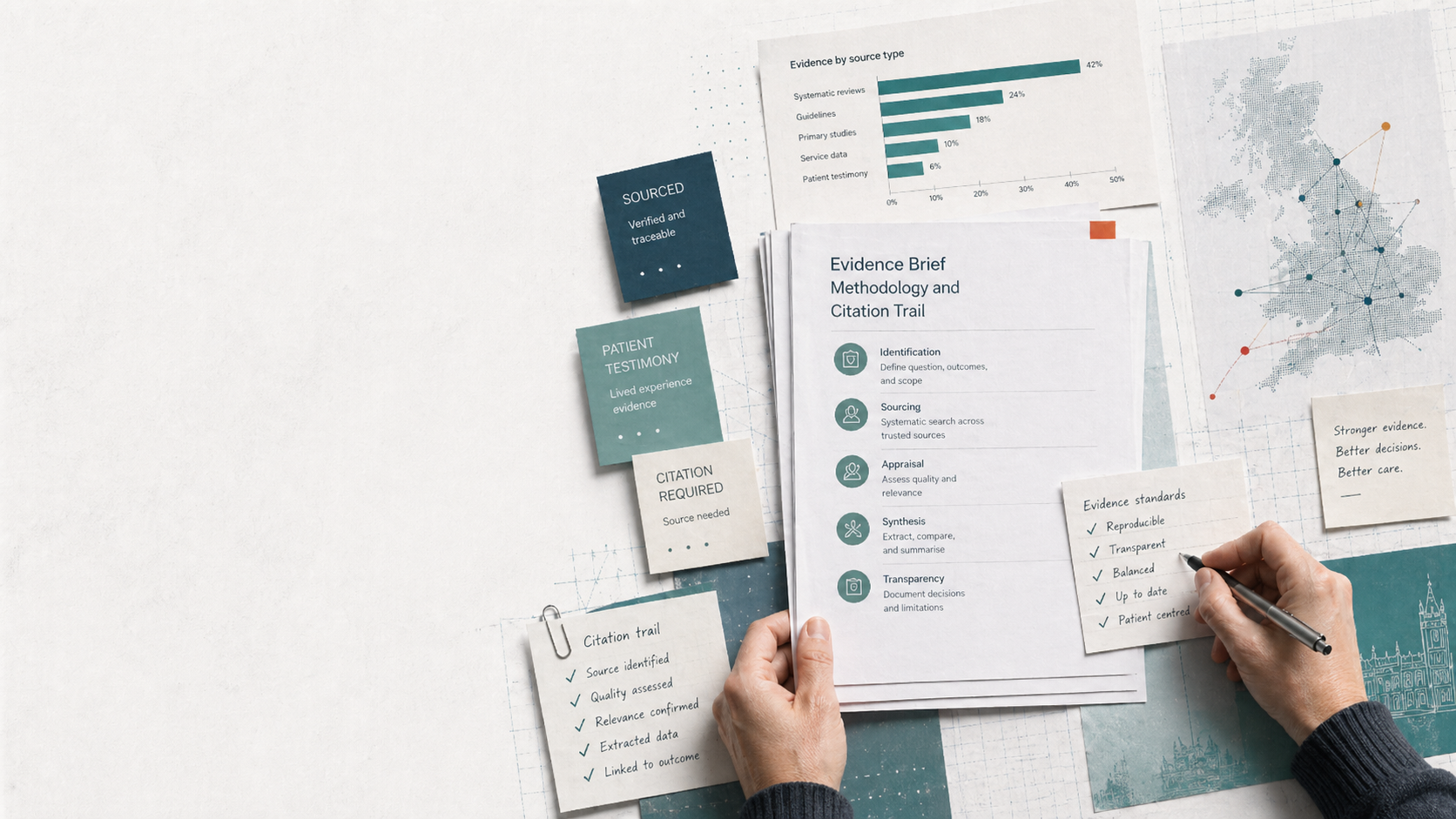
The campaign uses public evidence labels so readers can see whether a claim is sourced, testimony-based, or still awaiting verification.
Lived experience shows how pathways can break down, but it is not treated as clinical proof.
Important claims remain clearly marked until the source trail is verified.
Why labels are used
Evidence status is part of the public argument.
The campaign needs to be persuasive without turning patient experience into clinical proof or unresolved research into fact.
The campaign uses patient testimony to identify recurring patterns and policy questions. It does not use individual testimony as proof that a product works, that a treatment is suitable for everyone, or that a national prevalence claim has been established.
Definitions
What each evidence label means.
The labels are used consistently across public pages.
Published guidance, policy, official data, or peer-reviewed evidence carries the claim.
Lived experience shows how pathways can break down, but it is not treated as clinical proof.
Important claims remain clearly marked until the source trail is verified.
Future patient evidence
Patient evidence collection will require governance before launch.
The future route must handle consent, privacy, moderation, safeguarding, retention, withdrawal, and data access before any health-related personal data is collected.
Boundaries
What the campaign will not claim.
These rules keep the campaign aligned with its evidence discipline.
- It will not present individual testimony as proof of effectiveness.
- It will not recommend named products, ingredients, or routines.
- It will not claim that one treatment approach is suitable for everyone.
- Product-specific, ingredient-specific, probiotic strain, and mechanism claims must remain unpublished or marked Citation required until checked against reliable primary sources.
Updating gaps
Evidence gaps stay visible until resolved.
When a gap is sourced, it can move to Sourced. When it remains unresolved, it stays marked Citation required.
Open source trail
The sources page lists current source categories, citation gaps, and future source work.
View sources and gaps